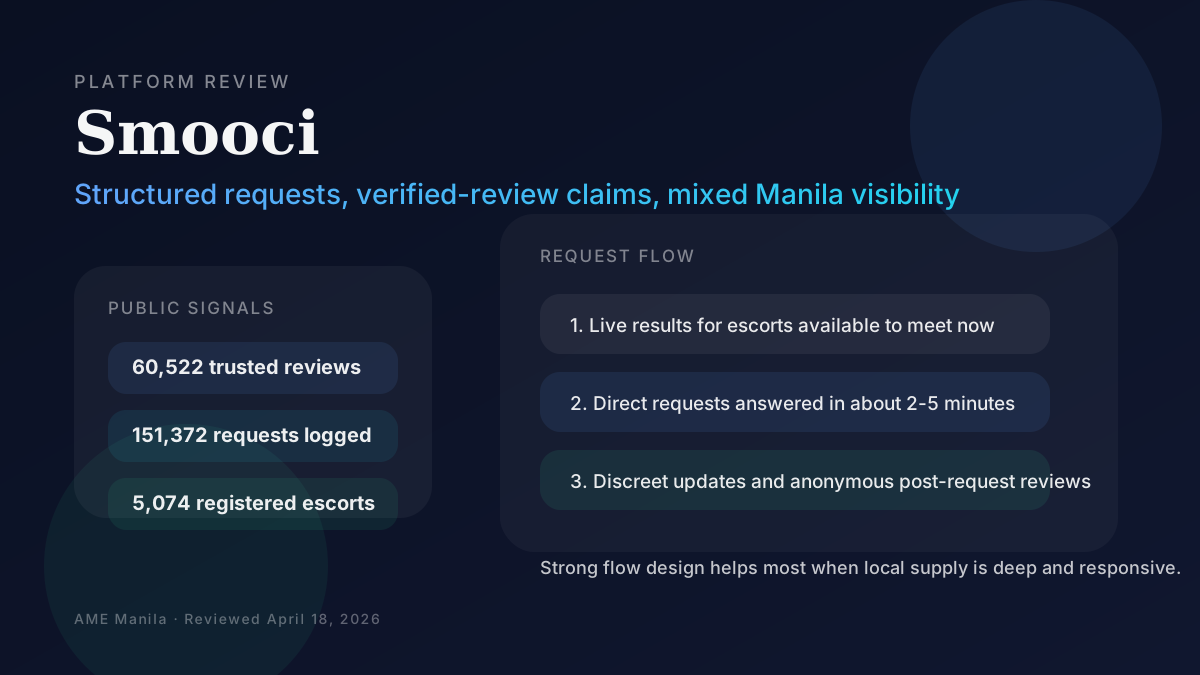
This Manila escort platform review looks at Smooci because it stands apart from legacy escort directories by turning booking into a guided request flow. Instead of acting mainly as a board of listings, it presents itself as a request-driven platform with verified reviews, discreet updates, and a cleaner chain between discovery and confirmation. Read it beside the Metro Manila escorts hub, escort reviews hub, and escort agencies directory so the platform promise is compared with AME's live local browsing routes. The harder question is whether the product's polish translates into a materially better Manila outcome or simply a better first impression.
60,522
Trusted reviews
151,372
Requests logged
2-5 mins
Reply target
5,074
Registered escorts
How We Reviewed Smooci
- Evaluated Smooci as a structured request product rather than as a classic classifieds directory.
- Focused on what the public product copy actually promises: live search, direct requests, discreet updates, verified reviews, support, and age or photo verification.
- Separated the value of better workflow design from the separate question of how visible Manila-specific depth and consistency are.
- Benchmarked the result against what Manila buyers usually need in practice: current activity, low-friction confirmation, review legibility, and support when a booking changes.
The goal is not to reward modern UX for its own sake. It is to test whether Smooci's structure meaningfully lowers booking friction and trust uncertainty for Manila users.
Smooci Scorecard
Verification structure
3/5Smooci publishes stronger trust language than a classic directory, including review and age or photo verification claims, but buyers still need to verify current reality themselves.
Booking flow
4/5The request-driven flow is the clearest operational advantage Smooci has over looser directory models.
Coverage depth
2/5The product works best when local supply is deep, and public Manila visibility still looks less legible than the polished platform layer.
Support and certainty
3/5Structured updates and support language help, but certainty still depends on the platform being able to keep the booking inside its own flow.
Value versus direct booking
3/5The product earns points for reducing chat chaos, but the user still has to decide whether the extra structure beats local directory breadth.
What Smooci Publicly Promises
The homepage language is unusually concrete for this category. Smooci claims 60,522 trusted reviews generated from 151,372 requests, says ratings and reviews are posted unedited, says a unique algorithm is used to identify suspicious feedback, and states that companions can receive age and photo verification from 24/7 support staff. It also highlights discreet requests, live status updates, premium messaging features, and quick support responses.
That is already a different level of product articulation than a typical directory. Smooci is not merely saying 'browse profiles and get in touch.' It is saying 'use our flow, trust our request and review mechanics, and let the platform reduce friction for both sides.' For buyers who dislike ambiguous chat-led booking, that is a meaningful distinction.
How the Structured Flow Differs From a Directory
- Start with live search results oriented around escorts available to meet now.
- Send a request directly to the escort through the platform rather than opening with an unstructured negotiation.
- Expect a response window framed as 2 to 5 minutes, with discreet notifications about delays or updates.
- Leave anonymous post-request feedback that Smooci says is published as part of its trusted review system.
That workflow matters because it changes the emotional shape of booking. Instead of asking the client to improvise the whole process from a listing page, it gives the user a narrow sequence. If the platform can keep the booking inside that sequence, it removes a lot of the small ambiguities that make classic directory use tiring.
Where the Product Design Helps in Practice
Smooci's design helps most in the messy middle of booking: confirming whether someone is genuinely reachable, reducing long back-and-forth exchanges, and surfacing a clearer sense of whether the booking is still moving. That is why the platform can feel more professional than a plain listings board even before you decide whether the local inventory is deep enough.
It also helps buyers who care about process but do not necessarily want an agency. Smooci frames itself as a technology company rather than an escort agency and explicitly says companions keep 100 percent of what they charge. For users who like independence on the provider side but still want more structured requests, that positioning is part of the appeal.
Process clarity is a product advantage, not automatic proof
A cleaner request flow can reduce confusion and ghosting. It does not automatically prove that the local supply behind the flow is deep, current, or equally reliable in every Manila district.
Reviews and Verification: Better Claims, Same Need for Caution
Compared with older directory models, Smooci clearly tries to tell a stronger trust story. The platform says reviews are private, real, and verified; says they are posted unedited; and says suspicious feedback is filtered by pattern checks. It also says verified profiles are highlighted after age and photo verification by support staff. Those claims are directionally strong and materially better than no process at all.
Still, the key limitation remains the same as on every platform: public claims about verification are not the same as a public audit trail. Buyers can reasonably conclude that Smooci takes review and verification design more seriously than a thin directory, but they should not conclude that every listing is equally fresh or equally low-risk. The platform likely reduces uncertainty; it does not erase it.
What Smooci's product promises give you and what to verify anyway
| Promise | Buyer benefit | Question to verify |
|---|---|---|
| Trusted reviews from completed requests | Stronger feedback logic than open posting | How representative those reviews are for the exact Manila area and time slot you need |
| Age and photo verification | Better onboarding discipline and highlighted verified profiles | How recent the verification is and whether the listing is still active right now |
| 2 to 5 minute response framing | Faster clarity on whether the booking is alive | Whether the quick response still leads to a real, workable confirmation |
| Support responds quickly to all clients | Stronger expectation of help than a bare directory provides | How support performs when the issue is complex, local, or last-minute |
| No commissions or booking fees | Cleaner positioning around provider earnings | Whether convenience still comes with narrower supply or premium-user upsell pressure |
What Manila Fit Looks Like Right Now
The official site currently gives mixed public visibility on Manila. The homepage banner highlights Pattaya, Phuket, Dubai, and Abu Dhabi as current launch markets, yet the footer still links Manila and Manila Transgender alongside other Asian cities. That means Manila is present in the platform's city structure, but the public front door does not make Manila depth especially legible.
That matters because Smooci's advantages compound when local supply is deep and responsive. A request-driven flow feels powerful when many relevant escorts are actually available through it. If the city depth is uneven, the same polished process can feel like a better interface wrapped around a shallower local market. This is the core Manila question for Smooci.
Support, Safety, and Dependence on the Platform
Historically, Smooci drew outside attention because it tried to bring app-style structure into escort booking, and that came with predictable safety questions about screening, privacy, and platform responsibility. The current public site responds to those concerns by leaning heavily on trust, privacy, anti-trafficking features, quick support, and verified-review language. That is a sign of product learning.
But there is still a practical limit. Smooci is strongest when the booking stays inside its own workflow from search to request to feedback. The moment the local market becomes thin, a plan changes, or a user needs a workaround outside the happy path, the platform's value depends on how well human support and local supply can keep up with the polished product promise.
Who Gets the Most Value From Smooci
The best fit is a user who hates the chaos of classic directories and is willing to trade some browsing freedom for more process control. If you want structured requests, faster status clarity, and a cleaner review story, Smooci is materially more appealing than a raw listings board. If you prioritize city-wide depth, broad comparison, and a very local Manila feel, it may feel more constrained.
AME as a Benchmark
AME is stronger when you want Manila-first breadth and easier comparison across many profiles, agencies, and trust cues. Smooci is stronger when you want the platform to do more workflow shaping. The better product depends on whether your priority is local coverage depth or process structure. Before choosing a platform-led route, compare the Manila escort booking guide, profile verification guide, and escort prices in Manila so the request flow is judged against local confirmation, safety, and rate expectations.
Final Verdict
Smooci is the most productized option in this review set, and that is a real advantage. Its request flow, review claims, and support language are meaningfully more structured than what classic directories usually offer. The Manila result, however, still depends on how deep and visible the local supply is behind that polished flow. In short: strong process design, but Manila value rises or falls with local depth.
References and Review Inputs
Smooci
Used for the homepage claims around trusted reviews, request volume, review policy, support, age and photo verification, and city links that include Manila. Accessed 2026-04-18.
VICE: Inside Smooci, the Sex Work App Described as 'Uber for Escorts'
Used as secondary background on Smooci's earlier product positioning, safety debates, and how the team framed the platform model. Accessed 2026-04-18.
How to book an escort in Manila
Internal AME guide used as a benchmark for a conventional Manila browse-contact-confirm flow.
Accessed 2026-04-18
How to verify escort profiles and avoid scams
Internal AME guide used as the verification benchmark for comparison.
Accessed 2026-04-18
Frequently Asked Questions
It is better for users who want a guided request flow and cleaner process structure. It is not automatically better for users who care most about maximum Manila browsing depth.
No. They make the trust story stronger than a thin directory, but users should still verify current activity, exact terms, and local fit before booking.
Process. The request-driven flow reduces ambiguity, speeds up response expectations, and gives the product a more coherent feel than old-school directories.
Whether the local inventory is deep and responsive enough for the polished workflow to deliver on its promise consistently across Manila.